<?xml version="1.0" encoding="utf-8"?><feed xmlns="http://www.w3.org/2005/Atom" xml:lang="en-US"><generator uri="https://jekyllrb.com/" version="3.10.0">Jekyll</generator><link href="thelifeelectric.us/feed.xml" rel="self" type="application/atom+xml" /><link href="thelifeelectric.us/" rel="alternate" type="text/html" hreflang="en-US" /><updated>2025-09-14T12:23:28-07:00</updated><id>thelifeelectric.us/feed.xml</id><title type="html">The Life Electric</title><subtitle>A (somewhat) live journal of my move to an electric vehicle, hoping to give others some insight if they want to make the plunge.</subtitle><author><name>Nate</name></author><entry><title type="html">Powering Up - From Chevy Bolt to Ioniq 6</title><link href="thelifeelectric.us/a-new-car" rel="alternate" type="text/html" title="Powering Up - From Chevy Bolt to Ioniq 6" /><published>2025-09-10T00:00:00-07:00</published><updated>2025-09-10T00:00:00-07:00</updated><id>thelifeelectric.us/a-new-car</id><content type="html" xml:base="thelifeelectric.us/a-new-car"><![CDATA[<p>Who can resist a good deal? Certainly not me, and so that’s why when NorCal Hyundai dealerships were offering insane lease deals for an Ioniq 6 SEL, I ended up jumping at it. In a whirlwind three days, I negotiated and picked up the lease and sold my old Bolt EUV.</p>

<p><img src="/assets/posts/ioniq.png" alt="Ioniq 6 SEL" /></p>

<p>There’s a lot I could say about the new car, and in general I like it a lot. It’s sleek, looks nice, has some weird, annoying quirks, but most importantly it’s a modern drivetrain and battery setup. And the biggest thing is the <strong>charge speed</strong>. It cannot be overstated how antiquated and frankly useless the Bolt family’s fast charging is. At 55 kW max, it’s painfully slow even in the best conditions, and would frequently average even less than that. If you read my old posts, you’d know that charging on a short road trip could easily be 20% or more of the total time, with hour stops just to drive another hour being common.</p>

<p>So when the opportunity to do <a href="/the-roadtrip">another SF to LA</a> road trip popped up, I expected this new car to be smoother. It claims to get 300 miles of range (vs the Bolt’s 240) and it charges five times faster than the Bolt at 250 kW. What I didn’t expect is that not only would it be smoother, but it would also completely change the experience of the road trip itself. Let’s look a little deeper at what went down.</p>

<h2 id="road-tripping-in-the-bolt">Road Tripping in the Bolt</h2>
<p>Before we get into what it’s like to road-trip in the Ioniq 6, let’s look back at what it was like in the Bolt. I’ve actually done three trips from SF to SoCal in the Bolt – the two I blogged about and another one to Santa Barbara that I didn’t bother documenting. The overarching theme in those trips was the <em>planning</em> involved. I’m not sure if it comes across in the blog posts, but it was a serious part of the trip.</p>

<p>Now, on one hand, I’m one of those freaks who actually enjoys logistical planning. Aside from being an EV driver, I’m also a private pilot, and as you’d expect, there’s a significant planning component in any trip going farther than a couple dozen miles. Eyeballing your fuel usage and realizing you need gas RIGHT NOW is a lot scarier when the consequence of not making it to a station isn’t having to push the car but exploding in a fiery wreck (I know, I know if you have no fuel, how will there be fire, bear with me here).</p>

<p>So I really didn’t mind the logistics overhead I had to embark on to drive the Bolt 350 miles. I’d plan out my route, try a bunch of different options, plan out contingencies so I could reroute if I used battery faster than expected, and just generally have an overall picture of exactly how the trip would pan out. It was fun, in a way. Unfortunately, this insane planning and the fact that each stop took upwards of an hour meant nobody ever wanted to drive with me.</p>

<h2 id="the-game-has-changed">The Game Has Changed</h2>
<p>Initially, I planned out this trip like I had all the others. The inputs were different, but still the same idea as before:</p>

<ul>
  <li><strong>Range</strong> had increased about 50 miles from the Bolt, which was a nice little bump to the time I could drive between stops.</li>
  <li><strong>Charge speed</strong> had quintupled from 50 kW to 250 kW, which made a massive difference in stop times.</li>
  <li><strong>Charger availability</strong> had increased quite a bit, especially with the addition of the Tesla network for Hyundai vehicles.</li>
</ul>

<p>I meticulously planned out the trip the night before, including which chargers I’d stop at and how long. And I stuck to the plan for a single stop. Turns out charging is way easier when it takes one-fifth the time.</p>

<p><img src="/assets/posts/fast-charge.png" alt="charging fast" /></p>

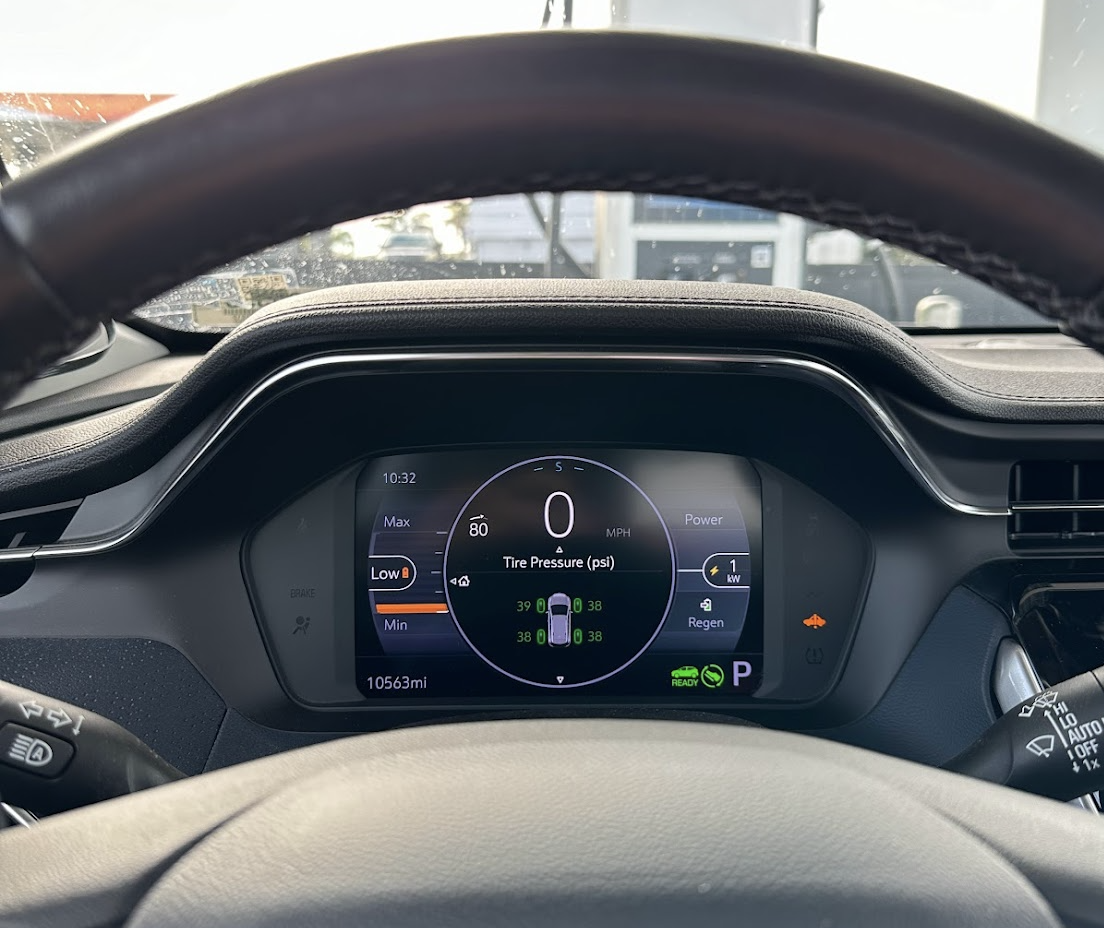
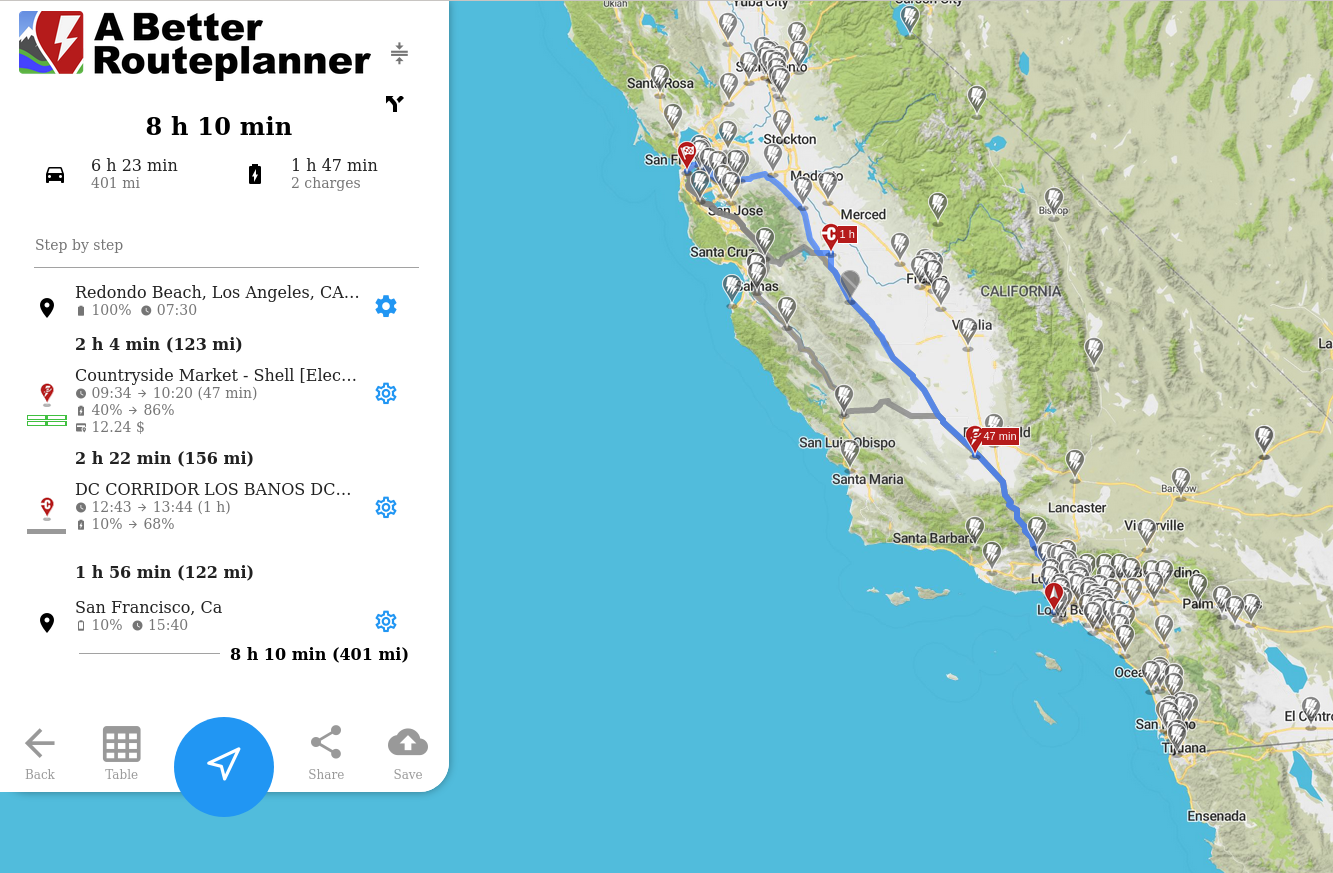
<p>When I originally planned out the trip, <a href="https://www.abetterrouteplanner.com">abetterrouteplanner.com</a> said I should expect to charge for 22 minutes at an EA charger and I’d be good to go. However, once I was actually on the road, my charge usage didn’t pan out exactly as planned. Mostly that was because, on a random weekday, the 5 was pretty empty and traffic was moving at about 80 mph+ the entire way. As anyone else with an EV knows, going 85 instead of 75 makes a big difference in drag and thus range. However, in terms of actual time spent on the road, you’re better off going faster because the car adds range much faster than you can drive. When I reached my planned stop, the route planner said I should expect 18% remaining and instead I was at 11%.</p>

<p>This presented a concern, because I was planning to arrive in LA with 20% remaining battery. If that number was actually more like 10%, then doing the climb over the Grapevine Pass could easily drop me into dangerous territory before the regen kicked in on the way down. So I did what I’d never do in the Bolt. I said “fuck it” and did it live.</p>

<p>My new plan was simple – drive until the car seemed low on charge and then just charge for a while as close as possible to the Grapevine Pass without going over it. I disconnected with 80% battery (which took an astounding 18 minutes to charge to) and just booked it down the freeway to a charging station that seemed promising. Once I arrived, I checked how much farther my destination was and charged until the range estimate was a good amount more than the estimated remaining distance. I felt especially comfortable doing this because (1) waiting until I had plenty of buffer was only maybe 5 more minutes and (2) there was a charging stop near the top of the pass itself. If I got to the top and realized I wasn’t going to make it, I could stop again and top off.</p>

<p>Sure enough, I made it to LA with plenty of charge to spare. Nearly 35% once I arrived.</p>

<h2 id="the-new-normal">The New Normal</h2>
<p>By far the biggest thing I realized on this trip was that the combination of fast charging and improved infrastructure meant that <strong>road tripping with an EV had basically become the same as in a gas car</strong>. Sure, it’s not quite as easy, but consider this:</p>

<h3 id="1-the-amount-of-planning-is-now-minimal">1. The amount of planning is now minimal</h3>
<p>On the way home, I abandoned any attempt to plan my trip. I simply found a station that looked like I’d be at about 20% charge when I arrived, and then drove until I was there. I got a coffee and continued until I needed a refill, and stopped again for a charge and coffee at the next charger I came to. Finally, I stopped one final time just for the bathroom because of all the aforementioned coffee, and snagged a little more charge just cause I could.</p>

<h3 id="2-there-are-way-more-chargers">2. There are way more chargers</h3>
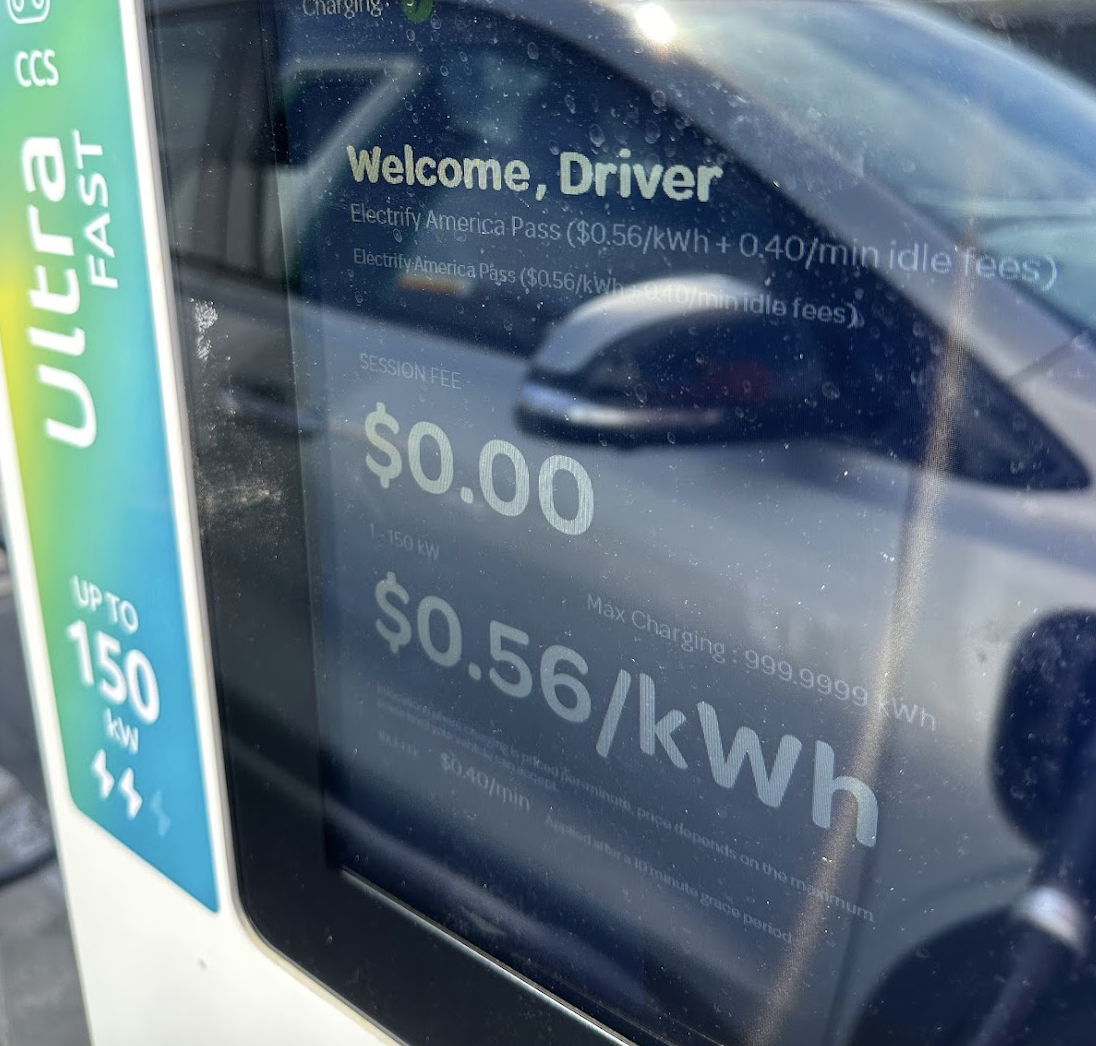
<p>Access to the Tesla network opens up a whole world of secondary charging options. I still aimed for Electrify America (EA) stations because I have their subscription and they have 350 kW stations that max out my car, but Tesla does a respectable 150 kW (I tested it before I left) and more importantly has a <strong>vast</strong> network. Not just in terms of how many stations, but also how many stalls are at each one. The EA network is bigger than before but it’s still maybe 10 stalls max to Tesla’s 80+ at some locations. Unless you’re going on a holiday weekend, it’d be unlikely you have to wait to charge.</p>

<h3 id="3-this-trip-took-just-as-long-as-a-gas-car">3. This trip took just as long as a gas car</h3>
<p>Each direction of this trip took about 6.5 hours. Without any stops, I’d guess it would be about 45 minutes faster. At most. Traffic is brutal in both cities, so unless you leave at 5am you’re not doing the 5.5 hours promised by Google Maps. I stopped once for lunch, and then one more time for a quick bathroom break and drink refresh. Even the lunch stops were fast, I’d say it felt about as fast as I’d eat during any normal road trip. It was probably 25 minutes from exiting the freeway to getting back on. I know some people are true hardos who want to just drive and eat in the car, but that’s not me and so as far as I’m concerned, I’m at time parity with my ICE car.</p>

<p>And before the internet “well ackchtually”s me to oblivion, I’m aware that:</p>

<ul>
  <li>This is a specific, well-traveled route with lots of infrastructure</li>
  <li>This is in fair weather and it wasn’t cold</li>
  <li>This isn’t that long a road trip</li>
</ul>

<p>I seriously do think that we’re fairly close to closing the road-trip gap for most people. With new technologies, there is always a shrinking list of things that the old thing did better. And yes, long trips, towing, cold weather – these are things that are still difficult for today’s EVs. But with this trip I think most of <em>my</em> road-trip needs are satisfied.</p>

<h2 id="trip-details">Trip Details</h2>
<p>Like the last blog posts, I’ll outline here the actual details of the trip so that others thinking of doing something similar have a benchmark from the real world.</p>

<h3 id="sf-to-la">SF to LA</h3>
<p>Average Temp: 83 F<br />
Distance: 379 miles<br />
Total time: 6:31<br />
Departure: Friday, 8am<br />
Average efficiency: 2.9 mi/kWh</p>

<p><strong>Charging details</strong></p>

<table>
  <thead>
    <tr>
      <th>Date</th>
      <th>Location</th>
      <th>Charging Time</th>
      <th>Total Energy Delivered</th>
      <th>Charging Price (pre-tax)</th>
      <th>Total Paid</th>
      <th>Start State of Charge</th>
      <th>End State of Charge</th>
    </tr>
  </thead>
  <tbody>
    <tr>
      <td>09/05/2025</td>
      <td>Kettleman City</td>
      <td>00:18:20</td>
      <td>52.1687 kWh</td>
      <td>$0.42/kWh</td>
      <td>$21.88</td>
      <td>14%</td>
      <td>78%</td>
    </tr>
    <tr>
      <td>09/05/2025</td>
      <td>Bakersfield</td>
      <td>00:13:00</td>
      <td>29.9000 kWh</td>
      <td>$0.48/kWh</td>
      <td>$14.35</td>
      <td>49%</td>
      <td>84%</td>
    </tr>
  </tbody>
</table>

<h3 id="la-to-sf">LA to SF</h3>
<p>Average Temp: 78 F<br />
Distance: 379 miles<br />
Total time: 6:23<br />
Departure: Monday, 7am<br />
Average efficiency: 2.7 mi/kWh</p>

<p><strong>Charging details</strong></p>

<table>
  <thead>
    <tr>
      <th>Date</th>
      <th>Location</th>
      <th>Charging Time</th>
      <th>Total Energy Delivered</th>
      <th>Charging Price (pre-tax)</th>
      <th>Total Paid</th>
      <th>Start State of Charge</th>
      <th>End State of Charge</th>
    </tr>
  </thead>
  <tbody>
    <tr>
      <td>09/08/2025</td>
      <td>Kettleman City</td>
      <td>00:19:48</td>
      <td>58.1758 kWh</td>
      <td>$0.42/kWh</td>
      <td>$24.40</td>
      <td>14%</td>
      <td>85%</td>
    </tr>
    <tr>
      <td>09/08/2025</td>
      <td>Firebaugh</td>
      <td>00:09:36</td>
      <td>19.0242 kWh</td>
      <td>$0.42/kWh</td>
      <td>$7.98</td>
      <td>58%</td>
      <td>80%</td>
    </tr>
    <tr>
      <td>09/08/2025</td>
      <td>Livermore</td>
      <td>00:06:23</td>
      <td>23.2000 kWh</td>
      <td>$0.48/kWh</td>
      <td>$11.13</td>
      <td>27%</td>
      <td>54%</td>
    </tr>
  </tbody>
</table>

<p>Until the next one!</p>

<ul>
  <li>N</li>
</ul>]]></content><author><name>Nate</name></author><summary type="html"><![CDATA[Who can resist a good deal? Certainly not me, and so that’s why when NorCal Hyundai dealerships were offering insane lease deals for an Ioniq 6 SEL, I ended up jumping at it. In a whirlwind three days, I negotiated and picked up the lease and sold my old Bolt EUV.]]></summary></entry><entry><title type="html">Roadtripping in a Chevy Bolt Part 2, Electric Boltaloo</title><link href="thelifeelectric.us/the-roadtrip-redux/" rel="alternate" type="text/html" title="Roadtripping in a Chevy Bolt Part 2, Electric Boltaloo" /><published>2024-02-16T00:00:00-08:00</published><updated>2024-02-16T00:00:00-08:00</updated><id>thelifeelectric.us/the-roadtrip-2</id><content type="html" xml:base="thelifeelectric.us/the-roadtrip-redux/"><![CDATA[<p>Welcome the sequel! After nearly two years, I was back for more. Once again it was time to tackle the roadtrip I once called “honestly not as terrible as you’d expect”. Los Angeles to San Francisco on nothing but electrons and a prayer (for no lines at EA chargers). For the original trip, check out <a href="/the-roadtrip-sf-to-la">part 1</a>.</p>

<p><img src="/assets/posts/initial-route.png" alt="the route" /></p>

<h2 id="the-car">The Car</h2>
<p>Some of you may recall that the Chevy Bolts of yore had a special feature that caused them to set spontaneously ablaze while charging. Partially thanks to GM, but mostly thanks to California’s progressive consumer protection laws, I was able to swap out my cute starter Bolt EV LT for the mature and sophisticated Bolt EUV Premier. The new car has been nothing but good to me so far, but unfortunately the extra mass combined with the same battery means range is reduced, approximately 20 miles EPA estimated. Charge rates are the same 55 KW, which is slower than basically any modern EV.</p>

<h2 id="the-trip">The Trip</h2>
<p>The route for this trip is nearly the same as last time, tackling nearly 400 miles mostly on the I5. Here are the overall stats for my trip:</p>

<div class="language-plaintext highlighter-rouge"><div class="highlight"><pre class="highlight"><code>Total milage: 380 miles
Total time: 8 hours 17 minutes
Average highway speed: 77 mph
Average driving efficiency: 3.3 mi/kWh
Average outdoor temp: 69 degrees
</code></pre></div></div>

<p>I stopped twice, for 34 minutes and 1 hour 10 minutes respectively. Usually I try to setup my charging so the first one is quick and the second one is longer and overlaps with lunch. Since I was traveling on a weekday, the roads weren’t busy save a few semis trying to pass each other. The worst traffic I hit was entering SF across the bay bridge and it was maybe an extra five minutes.</p>

<h2 id="infrastructure">Infrastructure</h2>
<p>While the trip is the same, a lot has changed in two years for the EV driver. There has been significant development on the charging infrastructure for this route, and while this sounds like it should make the trip easier it’s counteracted by the large increase in EVs on the road. I (along with many others) have observed that the number of cars has grown faster than the number of chargers for most non-Tesla networks. This has the potential to lead to one of the most frustrating electric road trip outcomes — waiting in line to charge.</p>

<p>This was a serious concern for me on my trip, so I purposely elected to make the drive early on a Tuesday, and luckily this seemed to work out. I didn’t have to wait for any chargers, although I did get the last spot at one location. However, having to wait for a spot can easily add half an hour to any stop, and if you’re unlucky enough to get stuck behind another slow charging Bolt it can be even longer. When many locations only have two to four charging bays, it’s easy to imagine that during the holidays a stop could take hours. Don’t forget to check ahead of stopping that your station has working and open chargers!</p>

<p>Tesla seems to have figured this out. Many of the charging locations I stopped at also had supercharger locations nearby, and the difference in investment is painful even just at a glance. Where Electrify America (EA) might have three spots, Tesla would have upwards of 50. Supposedly Tesla will be opening up its network to other cars, and while I’m excited about this personally, if I owned a Tesla I’d be pissed if a bunch of Chevy Bolts were about to start eating up an hour charging time each at the superchargers.</p>

<h2 id="charging">Charging</h2>

<p>While on my previous trip prices to charge varied widely, many networks have moved to simplified pricing models. I charged at EA chargers for both stops, and they charge a flat rate per kWh which is perfect for my slow charging Bolt that used to sometimes get charged per minute.</p>

<p>The first charger I used was a well outfitted EA station in a sea of gas stations. There were at least 8 stations here, including one with an F150 lightning charging off a 350 KW bay (neat!). Unfortunately, there wasn’t much to actually do in this location, since literally the only things open within walking distance were gas stations and fields. I opted to do a short charge and go for longer at the following stop.</p>

<p><strong>Charging Time: 34 minutes, Cost: $15.12</strong></p>

<p><img src="/assets/posts/low-power.png" alt="low power" /></p>

<p>Once you’ve taken enough trips like this you start to recognize the charging station names like old friends. Panoche Shell is one of the classics, just off the 5 and favorite recommendation of ABRP. Since this trip overlapped with lunch I went to a nearby casual burger place to eat, and then hung out for another 15 minutes on my laptop. When I went to leave, a man charging next to me who spoke no English used his Google translate app to ask me why his charge was so much more expensive than mine. I’m assuming my flustered description of kHw didn’t do a great job of explaining what was happening, but this does show an important education point — understanding how the pricing system works isn’t necessarily straightforward.</p>

<p><strong>Charging Time: 1 hour 10 minutes, Cost: $27.44</strong></p>

<h2 id="conclusions">Conclusions</h2>
<p>The obvious elephant in the room here is the cost.</p>

<p>Maybe due to California’s local “privatize the gains” utility PG&amp;E raising their rates massive amounts for homeowners, prices are much higher than I paid last time I took this trip. The total trip cost last time was $27.02, while this time it was $42.56! Combine that with home charging to go from 10% to 100% at $16.83 with PGE, and you’re looking at $59.39 for a one way trip.</p>

<p><img src="/assets/posts/the-cost.png" alt="damn the expense" /></p>

<p>Using the average gas price at the time of writing ($4.59) and a 30 mpg car, this is actually more expensive than the $58.16 in gas you would pay! Plus in a gas car you’d get there an hour faster at least depending on how quick you eat lunch. This is actually quite egregious in my opinion — I understand fast chargers aren’t cheap, but at least it was previously possible to point to the cost benefit even if charging took longer when potential EV owners asked about road trips.</p>

<p>Hopefully competition will lower charging rates once Tesla opens up their charging network but I’m not holding my breath. Until next time, enjoy living the life electric!</p>]]></content><author><name>Nate</name></author><summary type="html"><![CDATA[Welcome the sequel! After nearly two years, I was back for more. Once again it was time to tackle the roadtrip I once called “honestly not as terrible as you’d expect”. Los Angeles to San Francisco on nothing but electrons and a prayer (for no lines at EA chargers). For the original trip, check out part 1.]]></summary></entry><entry><title type="html">Roadtripping in a Chevy Bolt - LA to SF</title><link href="thelifeelectric.us/the-roadtrip/" rel="alternate" type="text/html" title="Roadtripping in a Chevy Bolt - LA to SF" /><published>2021-03-29T00:00:00-07:00</published><updated>2021-03-29T00:00:00-07:00</updated><id>thelifeelectric.us/the-roadtrip</id><content type="html" xml:base="thelifeelectric.us/the-roadtrip/"><![CDATA[<p>The day had arrived! Would I have a smooth trip or would I get stranded in Firebaugh, cursed to spend the night at a motel that smells like the cow farm next-door? Let’s find out!</p>

<p><img src="/assets/posts/new-route.png" alt="the route" /></p>

<p>For details on the preparations for the trip, see <a href="/the-roadtrip-setup/">my earlier post</a></p>

<h2 id="the-trip">The Trip</h2>
<p>Things went shockingly smoothly for a road-trip. I left LA at around 7am and arrived around 3:30pm in San Francisco, and some of that time was me stuck in gridlock 15 minutes into the journey because a huge car crash broke the 405 (seriously how is LA like this all the time?).</p>

<p>I stopped twice, once outside Bakersfield and again in Los Banos. Some trip stats:</p>

<div class="language-plaintext highlighter-rouge"><div class="highlight"><pre class="highlight"><code>Total milage: 401 miles
Total time: 8 hours 32 minutes
Average highway speed: 73 mph
Average driving efficiency: 3.4 mi/kWh
Average outdoor temp: 75 degrees
</code></pre></div></div>

<h2 id="charging">Charging</h2>
<p>Once I’d cleared LA traffic, the first leg of the trip went surprisingly well. I was worried that going through the mountainous grapevine would make the estimates of range inaccurate, but I arrived just 1 mile off from the Bolt’s estimate, which is pretty impressive. It was cool to get to the top of the pass and start the downhill leg, watching my battery charge up as I descended a few thousand feet over the course of a dozen miles.</p>

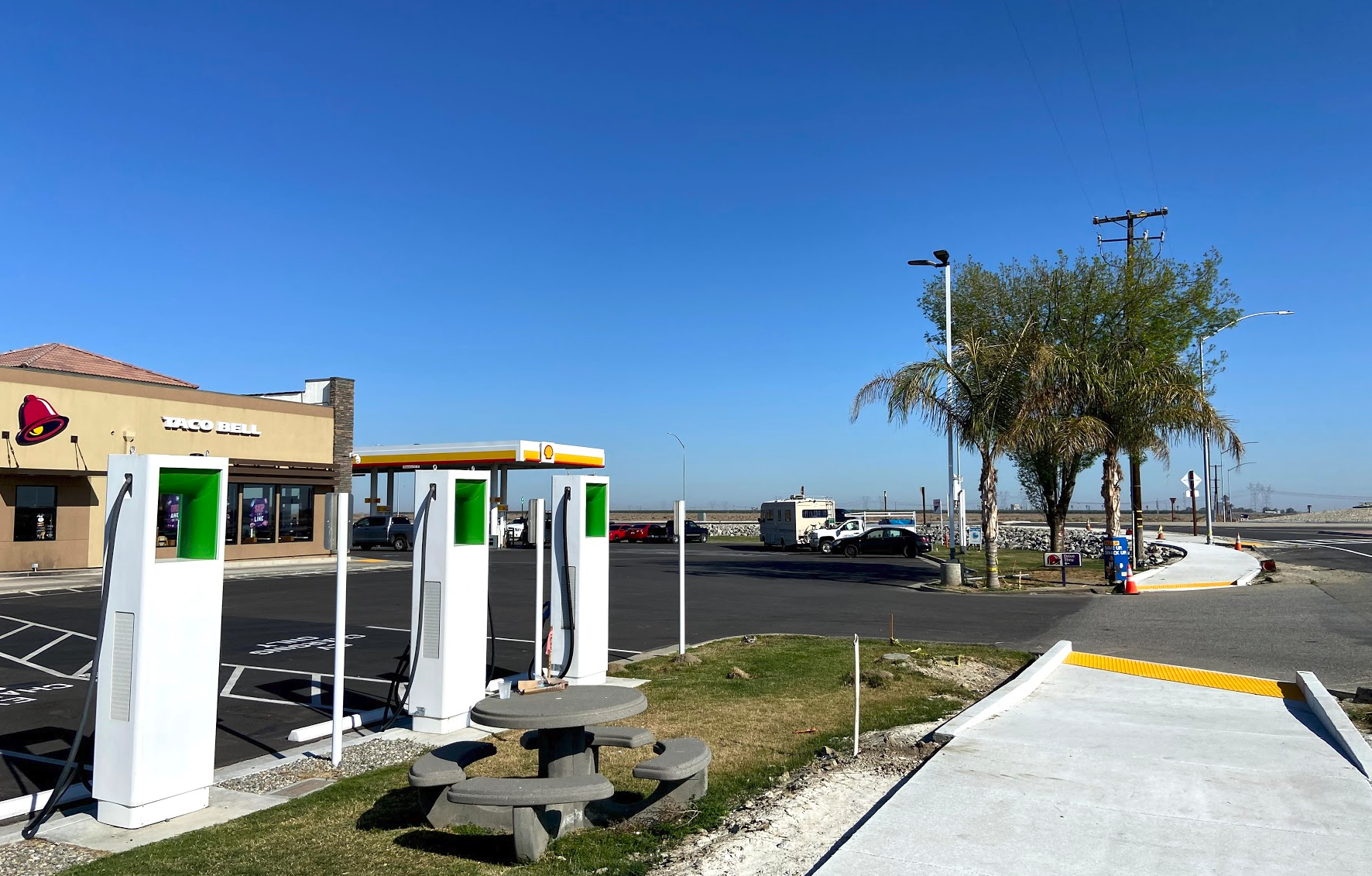
<p>The first charger was at a Shell station right off the highway. I parked in one of the three completely empty EV spots and started the fast charge. A quick bathroom and breakfast Taco Bell break later, and I was about halfway through the estimated 45 minute stop. From here I sat in the car and answered emails, trying to pretend I wasn’t skipping work for a road trip. Once the car hit 85% I stopped the charger and hit the road.</p>

<p><img src="/assets/posts/stop-one.png" alt="first stop" /></p>

<p><strong>Charging Time: 45 minutes, Cost: $8.68</strong></p>

<p>The second charger was a little more out of the way, located in a shopping center in Los Banos. Unlike the Shell, this charger was in the middle of a relatively dense commercial area. I started the charge and wandered off to try the new McDonald’s Chik-Fil-A knock-off. Pretty good, although the lack of sauces is a real point against ol’ Ronald.</p>

<p>After lunch, I swung by a grocery store to grab a couple of snacks and a drink, and by the time I was back at the car it had been an hour and the car was already charged enough for me to leave.</p>

<p><strong>Charging Time: 1 hour 1 minute, Cost: $18.34</strong></p>

<p>You’ll notice that the second stop was much more expensive than the first, even in cost per minute. I found that different chargers had very different pricing schemes. While still cheaper than gas, if you’re trying to save money you may want to shop around when you have options.</p>

<h2 id="some-lessons-learned">Some Lessons Learned</h2>
<ul>
  <li>It’s really nice that chargers are sometimes not just in a gas station. Especially once COVID is over, I imagine that stopping and hanging out in a cafe would be a really nice way to do the charging.</li>
  <li>Climate control is a real killer. I was lucky it was nice out, because when I tried turning on the A/C it knocked 40 miles off my estimated range. That’s a huge hit, and doing this trip in even mildly hot or cold weather would be a real bummer.</li>
  <li>The range estimate is usually pretty good, but not perfect. Until I get more familiar with it, I would want to leave at least 20 miles of range estimated when planning a trip.</li>
  <li>Related to the climate note, the heated seats and steering wheel are less a luxury item in EVs and more a range extender. They’re worth the 500 bucks or so they cost to add, since using them can mean 30+ miles of range over a long trip.</li>
  <li>Check if the chargers you plan to use are working ahead of time!</li>
</ul>

<h2 id="conclusions">Conclusions</h2>
<p>While it wasn’t the easiest road trip I’ve done, it was far less painful than I expected from an EV. With better charger coverage on the route, I probably would have been more comfortable with the margins and driven faster on the highway, but when you factor in things you’re already stopping for like meals it’s not adding that much more time to your trip.</p>

<p>That being said, if I was planning to road trip often I would probably prefer a long range Tesla, another EV with a higher rate of fast charge, or just rent an ICE car for those occasions. In different weather, this trip would have been especially painful as the climate control reduced range and required many more stops.</p>

<p>All in all, an easy and fun trip. Until next time!</p>]]></content><author><name>Nate</name></author><summary type="html"><![CDATA[The day had arrived! Would I have a smooth trip or would I get stranded in Firebaugh, cursed to spend the night at a motel that smells like the cow farm next-door? Let’s find out!]]></summary></entry><entry><title type="html">The Roadtrip Setup</title><link href="thelifeelectric.us/the-roadtrip-setup/" rel="alternate" type="text/html" title="The Roadtrip Setup" /><published>2021-03-26T00:00:00-07:00</published><updated>2021-03-26T00:00:00-07:00</updated><id>thelifeelectric.us/the-roadtrip-setup</id><content type="html" xml:base="thelifeelectric.us/the-roadtrip-setup/"><![CDATA[<p>Now that I had a plan to get back the old car, I still needed to get back the new one. Easy enough, just drive back up, right? Well I hadn’t planned to take this road trip in an electric when I came down, so now I was faced with figuring out the logistics with no time to prepare since I had to be back by the next week and it was Friday.</p>

<p>The first step in the plan was the first drive the car to LA and stay with a friend until Monday so I could get a feel for the vehicle and charge to 100% before I started the long haul. I learned from this that chargers are plentiful in the California area — there happened to be an L2 charger a block from my friend’s apartment. The charger was $1 an hour and had me fully charged in a 4 hour charge.</p>

<h2 id="routing">Routing</h2>

<p>The second step was to plan out a route that would get me back to San Francisco with energy to spare — I was brand new to EVs and wasn’t going to risk getting stranded out in the middle of the state with no power. I downloaded all the major charger apps (ChargePoint, Electrify America, EVGo) and used A Better Route Planner to do the routing.</p>

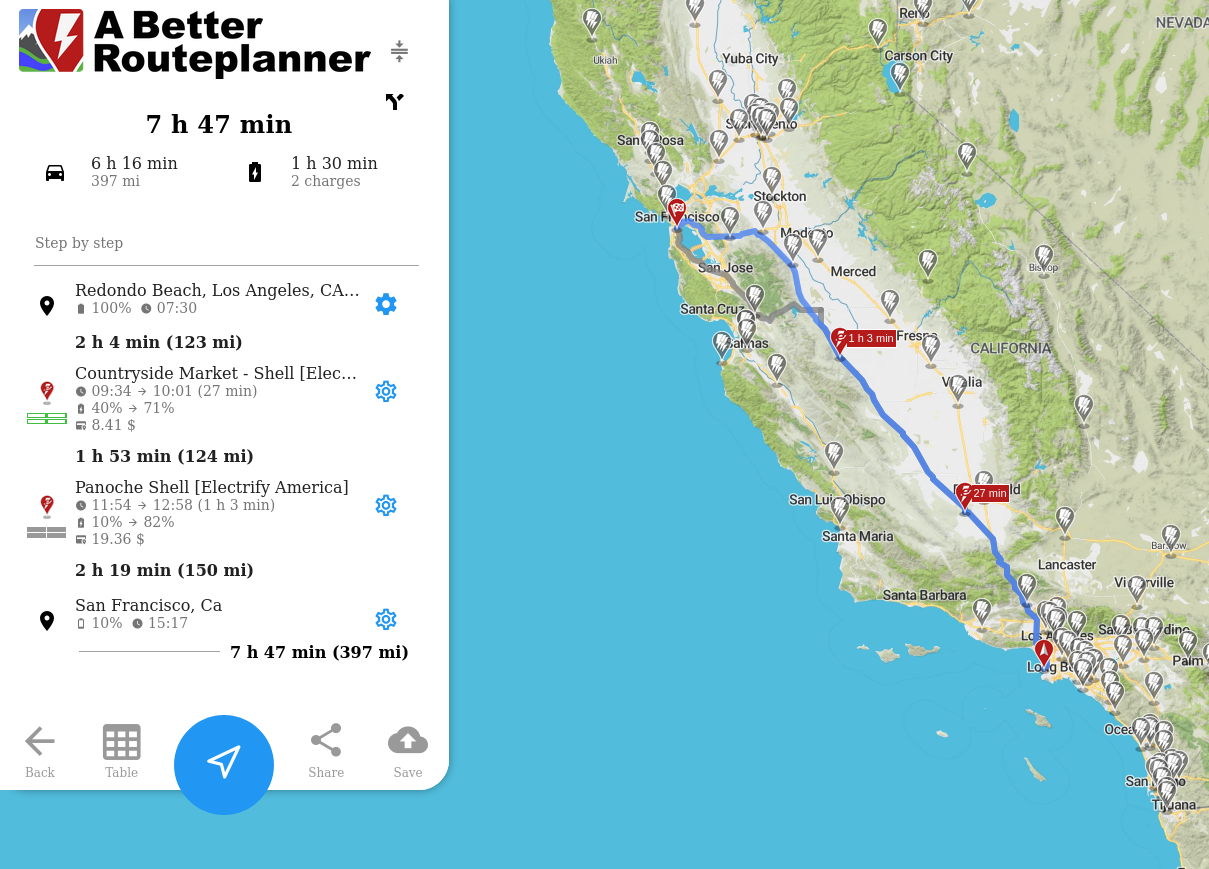
<p><img src="/assets/posts/initial-route.png" alt="initial" /></p>

<p>Easy! This route called for two stops, one about 45 minutes and the second about an hour. I figured I could overlap the second stop with lunch, and get back to the city by around 3pm if I left at 7am. I was all ready to go before I had a realization — what if a charging stop wasn’t working? The routing app didn’t have the status for some stations, and if I showed up and the plug was bad, I would be stuck finding a hotel with the distance that L3 plugs occur on the 5.</p>

<p>When I checked, sure enough, the second stop I wanted was out of service. I was able to avoid-list this site on the route planner and catch a charger maybe 50 miles before it instead. The moral of this story is <strong>verify that your chargers are working before you go!</strong> This ain’t Tesla; some of the networks do not take care of the stations, and on routes where the charger is the only one nearby you could be up a creek if you get stranded there. With the new route locked in, it was time to drive.</p>

<p><img src="/assets/posts/new-route.png" alt="initial" /></p>

<p><a href="/the-roadtrip/">Next: The Roadtrip</a></p>]]></content><author><name>Nate</name></author><summary type="html"><![CDATA[Now that I had a plan to get back the old car, I still needed to get back the new one. Easy enough, just drive back up, right? Well I hadn’t planned to take this road trip in an electric when I came down, so now I was faced with figuring out the logistics with no time to prepare since I had to be back by the next week and it was Friday.]]></summary></entry><entry><title type="html">The Purchase</title><link href="thelifeelectric.us/the-purchase/" rel="alternate" type="text/html" title="The Purchase" /><published>2021-03-25T00:00:00-07:00</published><updated>2021-03-25T00:00:00-07:00</updated><id>thelifeelectric.us/the-purchase</id><content type="html" xml:base="thelifeelectric.us/the-purchase/"><![CDATA[<p>I’ve always been pro-electric.</p>

<p>When Chevy first announced the Bolt in 2015, my roommate in grad school sent me an article outlining how the vehicle was the first real attempt by a major auto to compete with Tesla, and that GM was betting a lot of its future on the EV. I was stoked to see a glimpse of our electric future, but didn’t know at the time it would be <strong>my</strong> electric future.</p>

<p>Price has always been a sticking point on electrics, and I’m not what you’d call “price insensitive” on cars. Living in San Francisco makes the car more of a luxury item than a necessity, and I was raised on the idea that you should buy a reliable but affordable car and drive it into the ground over the course of 10 years. I figured it would be 3-5 years before I was willing to shell out for a $30k+ vehicle.</p>

<p>It started with a Reddit post.</p>

<p>While on vacation in San Diego, I learned that GM was trying to move the 2021 Bolts out of lots and that deals were dropping prices into $20k territory, making the Bolt downright affordable. Out of curiosity I searched dealerships near me and found deals in the $18k range for a brand new 2021 LT. I was sure it wasn’t real. Dealerships always advertise insane deals that only 5 people in the entire state qualify for just to get people in the door. I called, tried to figure out what the catch was. I finally caved and agreed to go in the next day to check it out.</p>

<p>One test drive later and a few incredulous quotes later and I was the proud owner of a brand new 2021 Bolt for $23k off the lot including all taxes and fees. As soon as the adrenaline wore off I realized I had a problems: my (now) old Honda Civic was still in San Diego and I now had two cars.</p>

<p>Whoops.</p>

<p>After some pleading and bribing of friends in the area, they agreed to watch the car until I could come back down and pick it up in a few months. Nice! One problem down.</p>

<p><a href="/the-roadtrip-setup/">Next: How to road trip the car back to San Francisco. Stay tuned!</a></p>]]></content><author><name>Nate</name></author><summary type="html"><![CDATA[I’ve always been pro-electric.]]></summary></entry></feed>